Food has its own value.
Soy foods and ground flax can bring nourishment to a meal, whether or not they change a menopausal symptom.

Women’s health · Dr. Michele Burklund
The shifting rhythms. The restless nights. The feeling that something is different. A place to understand this transition, explore the plants, and find your next step.
The woman within the transition
Perimenopause is the transition leading up to menopause. Changes in your cycle, temperature, sleep, mood, or vaginal comfort can become part of the picture. The experience is different for every woman. [1]
I begin with your story: what has changed, what you need help with, and what you want your life to feel like. Food, movement, rest, botanical medicine, and appropriate medical treatment can each have a place in that conversation.
This page opens one part of that conversation: the relationship between plants and the changing female body.
Ask about personalized careTHE DUTCH TEST
A closer look at your hormone patternsFrom my practice · Selected hormone testing
I use DUTCH hormone testing to explore sex hormones, their metabolites, and cortisol patterns alongside your symptoms, cycle history, sleep, and hormone use.
For the woman asking what is changing, testing can be one part of a thoughtful, individual assessment.
Order the DUTCH testView the exact panel, current price, collection instructions, and ordering eligibility on Fullscript. Discuss test selection and interpretation with your clinician; this test alone does not diagnose perimenopause.
About DUTCH hormone testing ↗The botanical field notes
Four plants. Different chemistries.
A more thoughtful way to explore them.
Phytoestrogens are plant compounds that can interact with estrogen receptors. The name describes a chemical relationship; it does not mean that a plant acts exactly like your body’s estrogen or a prescribed hormone.
The particular compound, preparation, dose, and tissue all matter. These plants do not automatically detect and correct a “hormone imbalance.” Their biology is more interesting—and more specific—than that. [2]
Here, I bring together the plants from my Medicine Wild phytoestrogen article, with a closer look at their constituents and their place in everyday life.
Soy foods and ground flax can bring nourishment to a meal, whether or not they change a menopausal symptom.
A cup of blossoms, a spoonful of seed, and an isolated compound deliver different mixtures and amounts.
A nourishing breakfast, an evening ritual, and treatment for disruptive hot flashes are different goals.
Get to know the plants
Start with the essentials. Open each field note for a little history, sensory character, and a personal invitation to reflect.
01 / The kitchen ally
Glycine max
Mild. Savory. Nourishing.
Soy belongs to longstanding East Asian food traditions, expressed through different preparations and fermentation practices.
Its mild flavor makes room for other ingredients. As a personal symbol, it can stand for the ordinary nourishment we return to again and again.
A thoughtful note: Avoid soy with a soy allergy. Concentrated isoflavone supplements need their own review; they are not equivalent to a serving of tofu.
02 / The nourishing thread
Linum usitatissimum
Nutty. Earthy. A little softness.
Flax has supplied both linen fiber and food. Its seed also has a long history in digestive traditions.
For personal reflection, the thread of flax can suggest continuity: what still sustains you while other parts of life are changing.
A thoughtful note: Increase fiber gradually and include fluids. Review supplements and medication timing with your clinician or pharmacist. [4]
03 / The meadow blossom
Trifolium pratense
Green. Grassy. Of the meadow.
Red clover connects meadow herbalism with the modern study of isoflavone-rich preparations. Its familiar blossom invites a closer look at an ordinary field.
As a personal symbol, I offer the image of quiet abundance: something small and beautiful growing close to the ground.
A thoughtful note: Avoid red clover supplements during pregnancy or breastfeeding. Review hormone-sensitive conditions and medications before use.
04 / The evening vine
Humulus lupulus
Bitter. Aromatic. Resinous.
Known through brewing and evening-rest traditions, hops has a distinctive bitter and aromatic character.
For personal reflection, the vine can represent making room for the day to end. That image is a ritual invitation, not a claim that hops will treat insomnia.
A thoughtful note: Review potential drowsiness, sedating medicines, and hormone-sensitive conditions with your clinician before choosing a hops preparation.
The symbolic meanings here are personal reflections. They are not presented as shared historical beliefs or medical effects.
Begin in the kitchen
Let food be something you enjoy, rather than another protocol to get perfectly right.
Stir food-grade ground flax into cooked oats. Add berries and a food you enjoy for protein. Begin with a small amount if fiber is new to your routine.
Pair cooked tempeh with greens, a grain, and a dressing you love. Its place on the plate begins with nourishment and flavor.
Add cooked, shelled edamame to a soup, salad, or rice bowl. A familiar, repeatable meal can be its own form of care.
Food · Infusion · Extract
Whole foods bring a mixture of nutrients and plant compounds. Choose for taste, nourishment, allergies, and your everyday needs.
Tea draws some constituents into water. Species, plant part, quantity, and brewing time change what ends up in the cup. An extract study does not tell us what a homemade infusion will do.
Read the species, plant part, extract, and active-ingredient information. Review it alongside medicines, hormone therapy, and other supplements before deciding whether it belongs in your care.
Make room for your own situation
Talk with your care team before using concentrated phytoestrogens if you have a hormone-sensitive condition, use endocrine treatment, are pregnant or breastfeeding, or take regular medications. Food and supplements deserve separate conversations. Unexplained bleeding—including any bleeding after menopause—needs medical assessment. [1] [9]
For disruptive hot flashes or other symptoms, discuss the full range of treatment options. Phytoestrogens are not interchangeable with prescribed hormone therapy.
Let’s talk about your care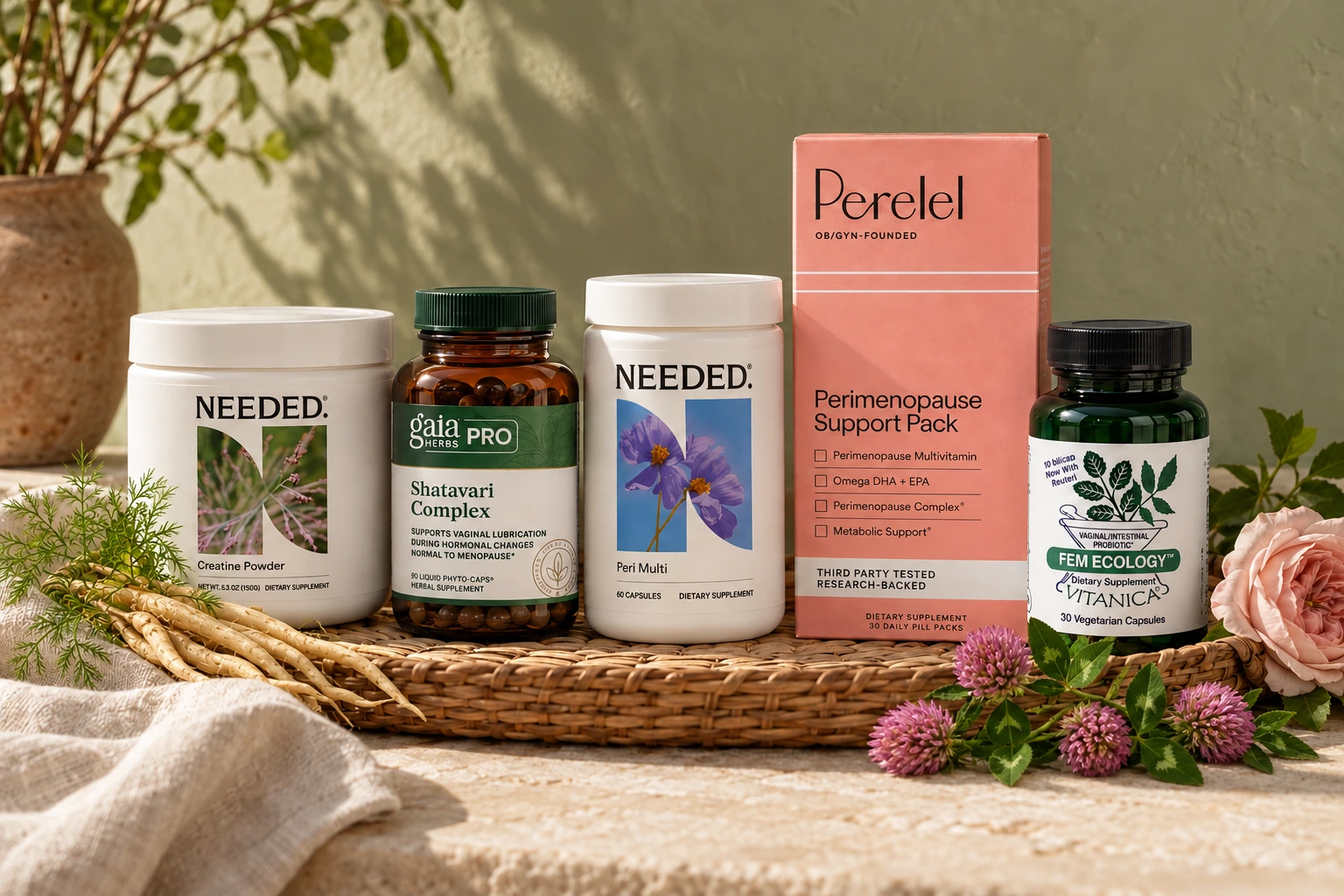
Dr. Michele Burklund’s collection
Thoughtful support for the changing female body.
Perimenopause asks us to pay attention. To the nights that feel different. The shifting rhythms. The woman we are becoming. I begin with nourishment, rest, movement, and listening to the body in front of me.
This is my personal edit of the botanicals and nutritional formulas I consider through a naturopathic and functional medicine lens—with room for strength, pleasure, and feeling at home in yourself.
Explore my Perimenopause ProtocolOpen my Fullscript collection. Explore individual products and choose what fits your needs.
Seven selections in my current collection. Browse the ingredients, product details, and available pricing on Fullscript.
01 / NOURISH
A nutritional starting point, chosen around your food, your history, and what you already take.
These are different options for a nutritional foundation. Review their overlapping ingredients before choosing.
02 / ENERGY & BONE
I include creatine here for cellular energy and mitochondrial support: it helps replenish ATP, the energy your cells use. Osteo-K is the bone-health selection.
03 / FEMININE ECOLOGY
Botanical tradition and the microbiome both have a place in my approach to the changing female body.
04 / THE INNER LIFE
Mood, sleep, and the demands of everyday life deserve their own conversation. This selection belongs within that individual assessment.
Review this formula’s ingredients and medicine interactions with your clinician before use.
Supplements & labs
My functional and naturopathic approach begins with your story. Laboratory testing can be part of a more individual assessment when it answers a useful question about your symptoms, history, or nutritional needs.
Explore the laboratory-testing guidance Discuss your needs in private careExclusive access to my Fullscript collection
You can order individual products. Take your time with the ingredients, ask questions, and choose only what is appropriate for you.
See the products selected for this edit.
Compare ingredients, directions, and current pricing.
Sign in or create an account to complete your purchase.
For help choosing products or doses, explore private care.
Your story comes first
Your symptoms and menstrual history are central to understanding the transition. Testing is considered when it can help answer a particular question; you do not need to order a large hormone panel to begin a conversation.
Explore the tests I have selected, then discuss which—if any—would change your care.
Shop the tests I use in practiceA little more clarity
They can interact with estrogen receptors, but they do not act as an automatic balancing system. The preparation, your health history, and the symptom being addressed all matter.
No. Soy foods provide a mixture of nutrients and constituents. A concentrated supplement may deliver a very different amount and mixture of isoflavones. Evaluate those choices separately.
Some soy preparations may offer a small benefit, but findings are inconsistent. Red clover and hops studies also have limitations. The Menopause Society’s 2023 statement does not recommend supplements or soy products as reliable treatments for hot flashes. That does not remove the nutritional value of soy foods. [10]
No. You can start with food, an assessment of your symptoms, and a conversation about sleep, movement, and what feels manageable. My free Foundations course is another place to begin.
Do not assume a concentrated botanical or isoflavone product is compatible with your treatment. Review the exact ingredients and dose with your prescriber or pharmacist. Ordinary foods are a separate conversation.
The wider conversation
For the curious
Adapted and expanded from my Medicine Wild article, with the references below for clinical context.