Look at the demands on your day
Consider sleep, workload, caregiving, regular meals, and the support available to you. A useful plan begins with the conditions surrounding the stress.

01 / The introduction
Make room for recovery.
The word adaptogen gathers very different plants into one conversation about stress and resilience. I prefer to meet them individually. A root, its tradition, a particular extract, and the person considering it each bring something different to the story.

02 / A note from Dr. Michele
When someone feels stretched thin, I begin with the demands on their life and the space available for recovery. Nourishment, sleep, daily rhythms, and support belong at the beginning of the conversation about resilience.
Adaptogens are distinct plants, each with its own history, preparation, and research. This edit is an invitation to meet them individually. I consider the person and the pattern first, then ask whether a particular botanical has a useful place in their care.
03 / Begin with the foundations
Consider sleep, workload, caregiving, regular meals, and the support available to you. A useful plan begins with the conditions surrounding the stress.
Choose something you can return to: a quiet evening, time outdoors, a regular meal, or gentle movement. The practice should make space in your life rather than become another demand.
If exhaustion continues, changes suddenly, or limits daily life, seek assessment. Adaptogens should not become a way to push through an unexplained symptom.
04 / Inside the Edit
Each selection has its own role. Read the preparation, consider what you already take, and choose what belongs in your routine.
01 / TRADITIONAL RESILIENCE
Individual selections, considered alongside the foundations of care.
02 / BOTANICAL VITALITY
Individual selections, considered alongside the foundations of care.
03 / RESTORATIVE TONICS
Individual selections, considered alongside the foundations of care.
04 / WOMEN’S HERBAL TRADITIONS
Individual selections, considered alongside the foundations of care.
05 / The science behind my selections

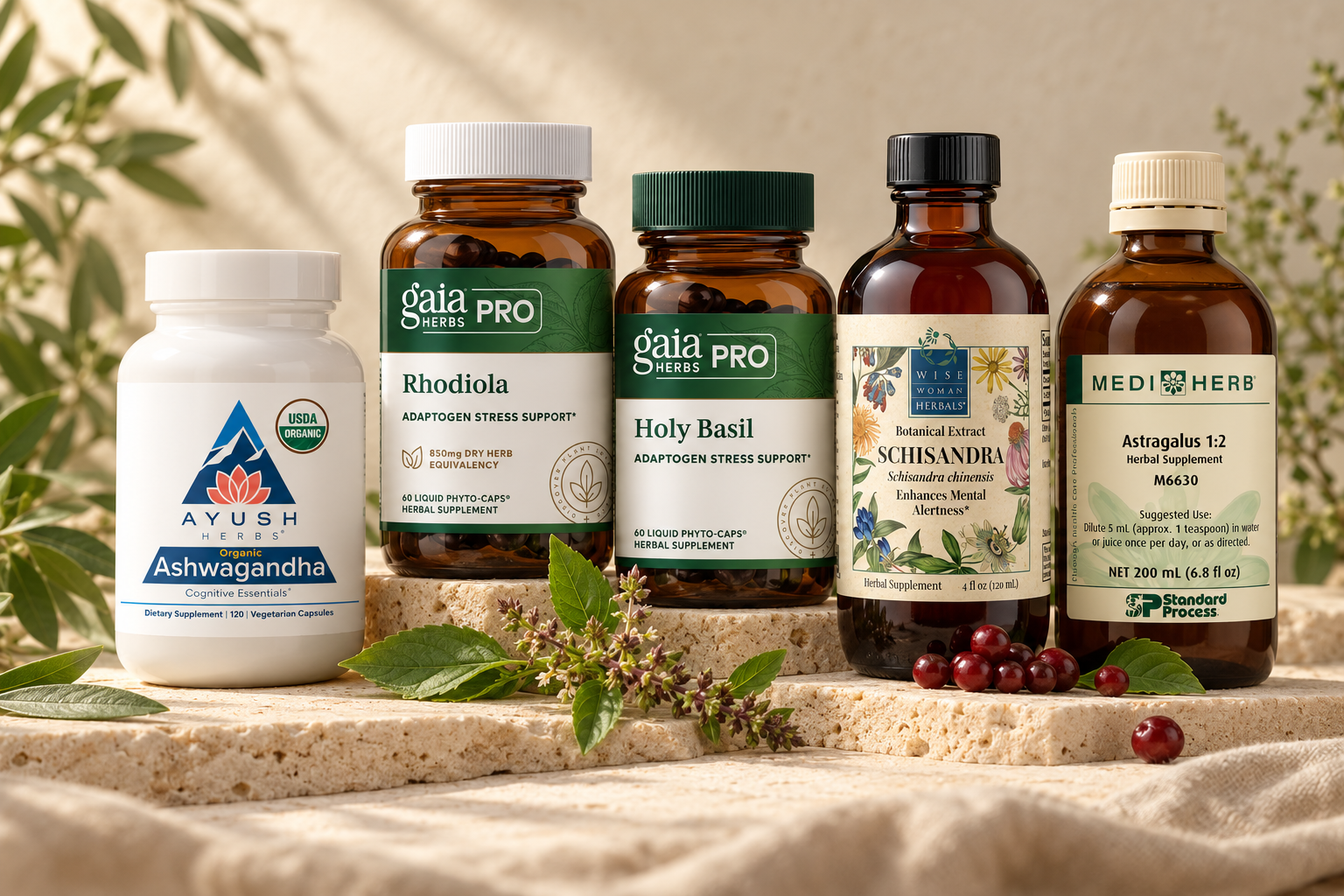
Ayush Herbs
The formulation. Withania somnifera. Plant part: Confirm the plant part on the current manufacturer label. Preparation: Ashwagandha extract capsules. Withanolides; the profile varies with plant part and extraction.
The physiology. An Ayurvedic rasayana traditionally associated with restoration and resilience.
The human evidence. Some short-term trials of particular extracts suggest benefits for stress and insomnia. Small samples, differing extracts and limited long-term data prevent a general claim for every ashwagandha product.
Individual considerations. Avoid in pregnancy and breastfeeding. Review thyroid or autoimmune disease and thyroid medicines, sedatives, immunosuppressants, anticonvulsants, glucose- and blood-pressure medicines. GI upset and drowsiness occur; rare liver injury is reported. The preparation matters as much as the plant name. Review this product’s Supplement Facts for the part used, extract strength and standardization; it has its own formulation, separate from the Gaia and Wise Woman options.
Shop This Product
Gaia Herbs Pro
The formulation. Rhodiola rosea. Plant part: Confirm the plant part on the current manufacturer label. Preparation: Liquid Phyto-Caps extract. Rosavins and salidroside; standardization differs among preparations.
The physiology. Russian and Scandinavian traditional use centers on fatigue and endurance.
The human evidence. Stress and fatigue studies are generally small and methodologically limited. NCCIH considers evidence insufficient for definite health conclusions; neither tincture nor capsule should promise restored adrenal function.
Individual considerations. Dizziness, headache, insomnia and dry mouth may occur. Review medications, including losartan; pregnancy and breastfeeding safety is not established. Rosavins are among the compounds described for this preparation. The current label can tell you more about the plant part, extraction and amount, which help distinguish one rhodiola product from another.
Shop This Product
Gaia Herbs Pro
The formulation. Ocimum tenuiflorum (syn. Ocimum sanctum). Plant part: Leaf. Preparation: Capsules with supercritical and water/alcohol extracts. Eugenol, rosmarinic acid, ursolic acid and other polyphenols.
The physiology. A sacred Ayurvedic plant traditionally used as a rasayana and for resilience.
The human evidence. An eight-week randomized trial of a named extract reported stress and sleep improvements. This is promising but does not establish every extract, long-term benefit or treatment of an anxiety disorder.
Individual considerations. Manufacturer guidance advises against pregnancy use. Review glucose-lowering medicines and other drugs; pregnancy, breastfeeding and longer-term safety remain insufficiently established.
Shop This Product
Wise Woman Herbals
The formulation. Schisandra chinensis. Plant part: Berry. Preparation: Water/alcohol liquid extract. Lignans including schisandrins; exact profile and quantity vary by extract.
The physiology. The five-flavor fruit is a long-standing Chinese tonic; its adaptogen framing developed later.
The human evidence. A small placebo-controlled menopause study and other limited human work are preliminary. Evidence does not establish general liver protection, athletic performance or equivalence of the two listed liquids.
Individual considerations. Review prescriptions because effects on drug handling can be clinically relevant. Use caution with hypertension, diabetes and psychiatric medicines. Pregnancy or breastfeeding use needs specialist review.
Shop This Product
MediHerb
The formulation. Schisandra chinensis. Plant part: Fruit. Preparation: 1:2 water/alcohol liquid extract. Lignans including schisandrins; exact profile and quantity vary by extract.
The physiology. The five-flavor fruit is a long-standing Chinese tonic; its adaptogen framing developed later.
The human evidence. A small placebo-controlled menopause study and other limited human work are preliminary. Evidence does not establish general liver protection, athletic performance or equivalence of the two listed liquids.
Individual considerations. Review prescriptions because effects on drug handling can be clinically relevant. Use caution with hypertension, diabetes and psychiatric medicines. Pregnancy or breastfeeding use needs specialist review. This description draws on an earlier label. Before choosing the product, check that the current formulation, strength and availability still match what you are looking for.
Shop This Product
Gaia Herbs Pro
The formulation. Eleutherococcus senticosus. Plant part: Root. Preparation: Eleuthero extract capsules. Eleutherosides are among the plant’s characteristic compounds. The amount in this particular preparation is not specified here.
The physiology. Known as Siberian ginseng, though not a Panax ginseng; traditional use concerns fatigue and weakness.
The human evidence. EMA regards fatigue/weakness use as traditional because trial limitations prevent firm conclusions. It does not validate broad claims to repair adrenal function.
Individual considerations. Insomnia, irritability, headache and rapid heartbeat have been reported. Review cardiovascular disease, hypertension and prescriptions. Pregnancy, breastfeeding and long-term use need assessment. Exact current marker standardization and full Supplement Facts require verification.
Shop This Product
Wise Woman Herbals
The formulation. Eleutherococcus senticosus. Plant part: Root. Preparation: Concentrated botanical syrup / solid extract in glycerin and honey. Eleutherosides are among the plant’s characteristic compounds. The amount in this particular preparation is not specified here.
The physiology. Known as Siberian ginseng, though not a Panax ginseng; traditional use concerns fatigue and weakness.
The human evidence. EMA regards fatigue/weakness use as traditional because trial limitations prevent firm conclusions. It does not validate broad claims to repair adrenal function.
Individual considerations. Insomnia, irritability, headache and rapid heartbeat have been reported. Review cardiovascular disease, hypertension and prescriptions. Pregnancy, breastfeeding and long-term use need assessment. Check the bottle size before ordering: this selection has appeared with both 4 oz and 60 mL descriptions. It contains honey and is not suitable for infants.
Shop This Product
MediHerb
The formulation. Astragalus membranaceus. Plant part: Confirm the plant part on the current manufacturer label. Preparation: 1:2 liquid extract as named in the PDF. Polysaccharides, saponins and flavonoids are among the plant’s constituents. Their amounts in this preparation are not specified here.
The physiology. A Chinese traditional root tonic associated with qi and resilience.
The human evidence. Reliable evidence is insufficient to establish benefit for a health condition. Small or low-quality studies of immune or metabolic markers do not justify broad immunity or disease-treatment claims.
Individual considerations. Avoid with autoimmune disease unless specifically supervised; it may interact with immunosuppressants. Pregnancy and breastfeeding safety is inadequately established. Review medicines and significant illness. This 1:2 preparation has its own formula, separate from the Wise Woman Astragalus option. Read the current label for the plant part, alcohol content and complete ingredients before choosing between them.
Shop This Product
Gaia Herbs Pro
The formulation. Asparagus racemosus. Plant part: Confirm the plant part on the current manufacturer label. Preparation: Multi-herb capsules with standardized shatavari extract. Steroidal saponins known as shatavarins; the listed formula contains additional botanicals. A shatavari-root extract blend with supporting botanicals including damiana, white peony, milky oats and tribulus.
The physiology. An Ayurvedic rasayana traditionally associated with reproductive health. Shatavari is used traditionally in Ayurveda for women’s health; its steroidal saponins and other compounds are being studied for menopausal support.
The human evidence. Small short-term trials of specific root extracts, including Aspurūs, report menopausal symptom improvement. They do not validate the complete Gaia multi-herb blend or establish long-term safety and hormone effects. Small ingredient studies and traditional use do not establish that this entire blend reliably relieves vaginal dryness or all menopausal symptoms.
Individual considerations. Review asparagus allergy, hormone-sensitive conditions, pregnancy, breastfeeding and all medicines. Safety review must cover every formula ingredient rather than shatavari alone; a current full label is needed. Shatavari is part of a wider botanical blend here. Gaia highlights Aspurūs shatavari, damiana, white peony, milky oats and tribulus. The complete current label matters, especially because some listings also mention rehmannia and epimedium. Research on shatavari alone cannot tell us how this finished blend performs. The product is not for pregnancy or lactation. Review hormone-sensitive conditions, medications and persistent vaginal discomfort with the clinician; symptoms may need a specific diagnosis and treatment.
Shop This ProductTHE ROOT IN THE STRESS & SLEEP CONVERSATION
Ashwagandha has a long history as a restorative root in Ayurveda. Modern studies of particular extracts have reported improvements in perceived stress and some measures of sleep, bringing a familiar traditional plant into a more specific clinical conversation.
I pay attention to how the extract is made and who is considering it. Root-only and root-plus-leaf preparations differ. Avoid it during pregnancy; thyroid or autoimmune conditions and medicines call for an individual safety review.
Some preparations have shown benefits for stress or sleep in human studies. Root-only and root-plus-leaf extracts differ, and the research does not settle long-term safety. Avoid use during pregnancy or breastfeeding. Thyroid and autoimmune conditions, medicines, and rare reports of liver injury need particular attention.
THE MOUNTAIN ROOT
Rhodiola grows in cold, mountainous regions, and its root and rhizome have a traditional association with stamina and resilience. Researchers have explored specific extracts for mental performance and fatigue during demanding periods.
It has a different character from a bedtime ritual. I consider the preparation, the pattern of fatigue, and sleep quality before deciding whether this plant belongs in someone’s care.
Rhodiola preparations generally use the root and rhizome. Its traditional association with stamina has prompted modern research, but reliable evidence is insufficient to establish broad health benefits. It may cause insomnia, headache, or dizziness; it is not simply a stronger version of a calming herb.
THE TRADITIONAL TONIC
Eleuthero root has a long tonic tradition connected with periods of tiredness and weakness. It is its own botanical species, distinct from Panax ginseng, despite the older common name “Siberian ginseng.”
Its place in the adaptogen conversation begins with that history and a carefully identified preparation. Persistent fatigue also deserves a look at sleep, nourishment, demands on the day, and any underlying health concern.
Eleuthero root has a traditional tonic history. That history does not establish a treatment for persistent fatigue, and clinical results are limited. Identify the species and preparation rather than relying on the older name Siberian ginseng. Review suitability if you have cardiovascular concerns or take medicines.
THE DETAILS THAT MAKE A PLANT SPECIFIC
A well-described extract gives you something concrete to understand: a species, a plant part, an extraction method, and a stated amount. Standardization tells you about a measured constituent; it helps describe a preparation.
I compare those details with the preparation used in research. A blend adds another layer, so I read every ingredient and look for overlap with the rest of the routine.
Read the species, plant part, extract details, serving information, and any standardization. Ask which preparation a study actually used and whether the study population resembles your situation. A blend introduces additional ingredients, interactions, and uncertainty about what is contributing to an effect.
06 / Shop the Edit
Explore the complete collection, then choose the individual products that fit your care. Fullscript provides current labels, pricing and availability.
Shop the Full Edit08 / The physician behind the Edit
09 / Related reading & collections
No. Read the selections as options, then choose around the question you want to address. I would look at the foundations, what you already take, and overlapping ingredients before adding anything. A thoughtful routine can be a small one.
At the beginning, and throughout. Food, sleep, movement, recovery, and your everyday environment shape the conditions in which a supplement might help. I want the routine underneath the formula to receive as much attention as the formula itself.
Yes. The whole guide is here for you to read. You only move into Fullscript when you want the current product label, availability, or ordering details. Take your time with the information first.
10 / Research & references
Individual preparation references appear with each selection. Traditional uses and laboratory findings are distinguished from human clinical evidence. These educational collections do not establish a physician–patient relationship. Purchases through the Fullscript links may financially support my practice.
Herbs grouped as adaptogens can have different effects and interactions. Discuss the exact formula with your clinician if you take medicines, have a thyroid, autoimmune, liver, cardiovascular, or psychiatric condition, or are preparing for surgery. Pregnancy and breastfeeding require a separate safety review.
The Foundations · My gift to you
Before protocols. Before supplements. Begin with water, nourishment, breath, and the everyday environment that supports your health.
Start My Free Foundations Course